Frequency Calculator
Calculate frequency in Hertz from period, or from wave speed and wavelength. Covers sound, light, radio waves, mechanical oscillations, and AC circuits.
c = λ × f • T = 1 / f • All values converted to SI units internally
Calculation Examples

How to Use the Frequency Calculator
The calculator supports two input modes depending on which variables you have measured:
1. Period-based: Enter the time for one complete cycle in seconds. Use this for pendulums, AC circuits, mechanical oscillations, and any repeating event where you can measure the cycle duration directly.
2. Wave-equation-based: Enter wave speed and wavelength. Use this for sound waves, electromagnetic waves (light, radio, microwaves), and any traveling wave where you know its spatial and propagation characteristics.
Before entering values, convert all inputs to standard SI units: seconds for period, meters for wavelength, and meters per second for wave speed. Entering wavelength in centimeters without converting to meters is the most common source of error. The result appears in Hertz (Hz), representing cycles per second. For results in kHz, MHz, or GHz, divide the Hz output by \(10^3\), \(10^6\), or \(10^9\) respectively, or use the built-in unit selector.
The Frequency Formula and Its Mathematical Basis
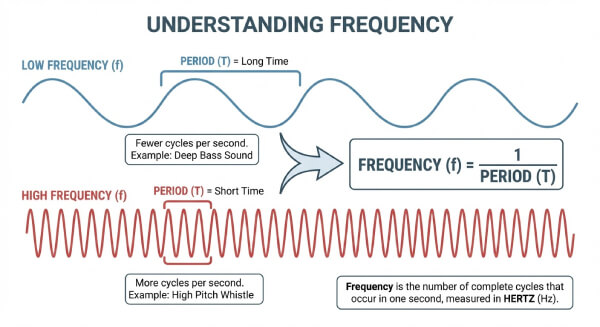
Frequency is defined by the International System of Units (SI) as the number of complete cycles of a repeating event per second, measured in Hertz (Hz = s⁻¹). The two fundamental formulas are: \[f = \frac{1}{T}\] where \(f\) is frequency in Hz and \(T\) is the period (duration of one cycle) in seconds; and \[f = \frac{v}{\lambda}\] where \(v\) is the wave's phase velocity in m/s and \(\lambda\) is its wavelength in meters.
Two propagation speeds are constants rather than variables: the speed of light in vacuum is \(c = 299{,}792{,}458\) m/s exactly (SI definition), used for all electromagnetic wave calculations; the speed of sound in dry air at 20°C is approximately 343 m/s (varies with temperature at roughly 0.6 m/s per °C). For other media, the phase velocity must be measured or looked up — sound travels at approximately 1,480 m/s in water and 5,100 m/s in steel, so using the air value in those contexts gives a result off by a factor of 4–15. A practical example: an FM radio station broadcasting at 100 MHz has a wavelength of \(\lambda = v/f = 3 \times 10^8 / 10^8 = 3\) m. A standard A4 musical note at 440 Hz in air at 20°C has a wavelength of \(\lambda = 343 / 440 \approx 0.780\) m.
Useful Tips 💡
- For electromagnetic waves in vacuum, always use \(c = 299{,}792{,}458\) m/s exactly. For calculations where \(3 \times 10^8\) m/s is sufficient precision, the error is only 0.07%.
- Frequency and period are exact reciprocals: doubling the frequency halves the period. If a system oscillates at 50 Hz, its period is exactly 0.02 s (20 ms).
- In medical imaging, ultrasound frequencies range from 2 to 18 MHz. In RF engineering, Wi-Fi operates at 2.4 GHz and 5 GHz. Always verify your result is in the expected order of magnitude for your application.
- Angular frequency \(\omega\) (measured in rad/s) is not the same as ordinary frequency \(f\) (measured in Hz): \(\omega = 2\pi f\). Many physics equations use \(\omega\); always check which form is required before substituting.
📋Steps to Calculate
-
Select the input mode: Period-based (enter \(T\) in seconds) or Wave-based (enter \(v\) in m/s and \(\lambda\) in meters).
-
Enter all values in standard SI units. Convert prefixes first: milliseconds to seconds, centimeters to meters.
-
Click Calculate to see the frequency in Hz and the formula applied.
-
For results in kHz or MHz, divide by \(10^3\) or \(10^6\), or use the unit selector.
Mistakes to Avoid ⚠️
- Entering wavelength in centimeters or nanometers without converting to meters. A 500 nm visible light wavelength entered as 500 instead of 0.0000005 m produces a frequency result billions of times too small.
- Confusing angular frequency (measured in rad/s) with ordinary frequency (measured in Hz). They differ by a factor of approximately 6.283 (2 times pi).
- Entering the total duration of multiple oscillations as the period of one. If a pendulum completes 10 swings in 20 seconds, the period of one swing is 2 s, not 20 s.
- Using the speed of sound in air (343 m/s) for calculations in water or solid materials. The correct phase velocity must match the propagation medium.
Practical Applications of Frequency Analysis📊
Acoustics and audio engineering: Calculate the frequency of sound waves for speaker crossover design, room acoustic analysis, and musical instrument tuning.
RF and wireless communications: Determine the frequency and wavelength of radio, microwave, and cellular signals for antenna sizing and spectrum allocation.
Mechanical engineering: Identify the natural vibration frequency of structures and components to detect and avoid resonance conditions that cause fatigue failure.
Electrical power systems: Verify the frequency of AC power signals (50 Hz in Europe and Asia, 60 Hz in North America) and analyze harmonic distortion in power grids.