Watt Calculator
Calculate electrical power in watts from any two of three variables: voltage, current, or resistance. Covers all three power formulas and both DC and resistive AC circuits.
For DC circuits only. Uses standard physics formulas (Ohm's Law + Watt's Law). Enter the values required for the selected method. Results are for reference, always verify with a qualified electrician for real-world safety.
Calculation Examples

How to Use the Watt Calculator
Identify which two of the three circuit parameters you know — voltage (V), current (A), or resistance (Ω) — and select the matching calculation mode. Enter both values in standard SI units: volts for voltage, amperes for current, ohms for resistance. If your measurement is in milliamperes, divide by 1,000 before entering (e.g., 500 mA = 0.5 A).
For AC circuits, the formulas apply directly only to purely resistive loads (heaters, incandescent bulbs, resistive heating elements). For inductive or capacitive loads (motors, transformers, switching power supplies), real power depends on the power factor \(\cos\varphi\): \(P = V \times I \times \cos\varphi\). Use RMS values for both voltage and current in AC calculations — peak voltage divided by \(\sqrt{2}\) for sinusoidal waveforms. The calculator computes real power (watts); for apparent power (VA) or reactive power (VAR), an impedance calculator is needed.
Understanding the Electrical Power Formula
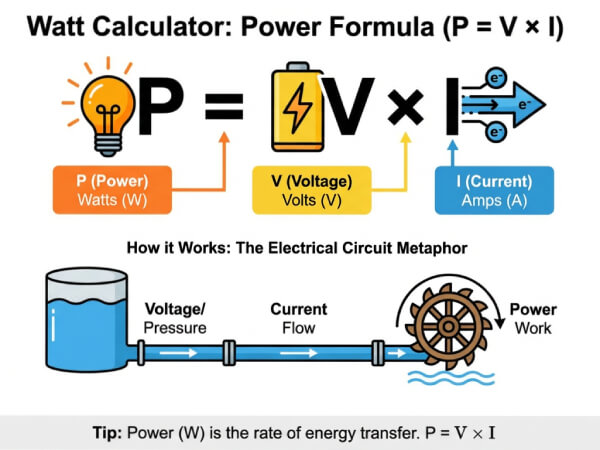
Electrical power is the rate of energy transfer in a circuit, measured in watts (W = J/s). The three equivalent forms of the power equation, established as global standards by the International Electrotechnical Commission (IEC) and verified against IEEE definitions, are: \[P = V \times I\] \[P = \frac{V^2}{R}\] \[P = I^2 \times R\] The first form (\(P = VI\)) is the most direct: multiply the potential difference (voltage) by the current flowing through the component. The second form (\(P = V^2/R\)) is useful when only voltage and resistance are known — common for fixed-voltage sources like wall outlets. The third form (\(P = I^2 R\)) is the basis for Joule's Law of resistive heating: the power dissipated as heat in a conductor is proportional to the square of the current, which is why doubling the current quadruples the heat loss.
A practical example of why precision matters: a 14-gauge copper wire (common in U.S. residential wiring) has a resistance of approximately 8.45 mΩ per meter. At 15 A, it dissipates \(P = (15)^2 \times 0.00845 = 1.9\) W/m as heat. Over a 30-meter circuit run, that is 57 W of continuous heat dissipation — enough to matter for conduit fill calculations and circuit breaker sizing under NEC Article 310.
Useful Tips 💡
- For AC circuits, always use RMS values: for a standard 120 V U.S. outlet, the RMS voltage is 120 V and the peak voltage is approximately 170 V. Using peak instead of RMS overstates power by a factor of 2.
- Add a 20% safety margin to calculated wattage when selecting fuses, circuit breakers, or power supply units. A circuit loaded to exactly its rated wattage leaves no headroom for startup surges.
- Watts measure instantaneous power rate; watt-hours measure total energy consumed. A 100 W bulb running for 10 hours consumes 1 kWh, which is the unit used on utility bills.
- In DC circuits, \(P = V \times I\) is always exact. In AC circuits with non-resistive loads, apparent power (VA) exceeds real power (W) by the power factor. Always clarify which is specified in equipment datasheets.
📋Steps to Calculate
-
Select the calculation mode based on your known variables: V and I, V and R, or I and R.
-
Enter both values in standard SI units (volts, amperes, ohms). Convert prefixes first: mA to A, kΩ to Ω.
-
For AC circuits, confirm your voltage and current are RMS values, not peak values.
-
Click Calculate to see the power in watts and the formula applied.
Mistakes to Avoid ⚠️
- Entering milliamperes as amperes without converting: 500 mA entered as 500 A produces a result 1,000,000 times too large. Always convert to base SI units first.
- Applying the direct power formula (voltage times current) to AC motor loads without a power factor correction: a motor drawing 10 A at 120 V has an apparent power of 1,200 VA, but real power may be only 960 W if the power factor is 0.8.
- Confusing apparent power (VA) with real power (W): equipment like UPS units and generators are rated in VA, while energy consumption is billed in watts (kWh). They are equal only for unity power factor loads.
- Ignoring source resistance in high-precision calculations: a battery with 0.1 ohm internal resistance delivering 10 A drops 1 V internally, dissipating 10 W as internal heat that does not reach the load.
Practical Applications of Wattage Calculations📊
Home energy auditing: Calculate the actual power draw of appliances from nameplate voltage and current ratings to estimate monthly electricity cost.
Renewable energy systems: Size solar panel arrays, battery banks, and inverters by calculating the total watt load of the connected devices.
Circuit design and thermal management: Use \(P = I^2 R\) to calculate heat dissipation in PCB traces, cables, and resistors to prevent thermal failure.
UPS and generator sizing: Determine total connected load in watts to select a correctly rated uninterruptible power supply or backup generator with adequate headroom.