Mass and Weight Converter
Convert Mass and Weight Units: Metric, Imperial, and Scientific
Calculation Examples

Mass vs. Weight: What is the Difference?
In everyday language, mass and weight are used interchangeably, but in physics they describe fundamentally different quantities. Mass is the measure of the amount of matter in an object, expressed in kilograms or grams, and remains constant regardless of location. Weight is the gravitational force acting on that mass, expressed in Newtons, and varies depending on the local gravitational field. This relationship is defined by Newton's second law: $$W = m \times g$$ where $W$ is weight in Newtons, $m$ is mass in kilograms, and $g$ is the standard acceleration due to gravity on Earth, defined as exactly $9.80665\text{ m/s}^2$ by the International Bureau of Weights and Measures (BIPM).
How the Conversion Logic Works
Mass-to-weight conversion uses the formula $W = m \times g$, where $g = 9.80665\text{ m/s}^2$ on Earth. To reverse the calculation and find mass from a known weight in Newtons, the formula becomes $m = W \div g$. All unit-to-unit mass conversions use exact or high-precision fixed factors: 1 kilogram equals 1,000 grams; 1 kg equals 2.20462 pounds; 1 pound equals 16 ounces; 1 stone equals 14 pounds (6.35029 kg); 1 metric tonne equals 1,000 kg; 1 centner equals 100 kg. These constants are consistent with the International System of Units (SI) as maintained by BIPM and with US customary unit definitions maintained by NIST.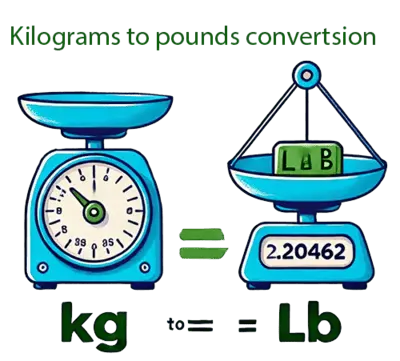
Useful Tips 💡
- If you are tracking body weight in the UK, note that 1 stone equals exactly 14 pounds. A person weighing 11 stone 4 pounds weighs 158 pounds or approximately 71.7 kg.
- In physics and engineering, always distinguish between mass (kg) and weight (N). Specifying the wrong quantity in a structural or aerospace calculation can produce results that are off by a factor of roughly 9.8.
📋Steps to Calculate
-
Enter the numeric value you wish to convert.
-
Select the source unit (for example, Kilograms) and the target unit (for example, Stones or Newtons).
-
Click "Calculate" to receive the converted mass value and, where applicable, the equivalent gravitational force in Newtons.
Mistakes to Avoid ⚠️
- Confusing net weight with gross weight in shipping and customs. Net weight is the mass of the goods alone; gross weight includes all packaging, pallets, and containers.
- Using the rounded factor of 2.2 lbs per kg in precise calculations. The exact value is 2.20462 lbs per kg; for a 100 kg load, the rounding error is 0.462 lbs, which matters in pharmaceutical dosing and engineering tolerances.
- Treating ounces (a unit of mass) as equivalent to fluid ounces (a unit of volume). One fluid ounce of water weighs approximately 1.04 ounces by mass, but for denser or lighter substances the difference is much larger.
Practical Applications📊
Convert body weight between stones, pounds, and kilograms for health tracking, medical records, or fitness apps that use different unit systems.
Translate shipping and cargo weights for international logistics, customs declarations, and freight pricing where metric and imperial systems intersect.
Solve physics and engineering problems by converting mass to weight in Newtons using the standard gravitational constant or an environment-specific value.