Height Converter
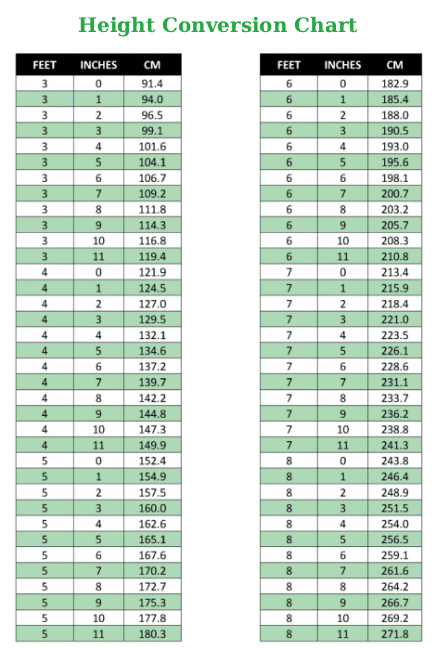
Convert Height Between Metric (cm/m) and Imperial (ft/in) Units
Exact international standards • 1 in = 0.0254 m • 1 ft = 0.3048 m
Calculation Examples
📋Steps to Calculate
-
Select your starting unit (Centimeters, Feet and Inches, or Meters).
-
Enter the height value. For feet and inches, use the dual input fields for whole feet and remaining inches separately.
-
Click "Calculate" to see the equivalent height in all other supported units simultaneously.
Mistakes to Avoid ⚠️
- Entering 5 ft 11 in as the decimal 5.11 feet. The value 5.11 feet is actually approximately 5 ft 1.3 in, a difference of nearly 10 inches from the intended height.
- Rounding 1 foot to 30 cm instead of the exact value of 30.48 cm. For a person 6 feet tall, this rounding error accumulates to over 2.8 cm.
- Confusing meters with yards. One meter equals approximately 1.094 yards, meaning a meter is about 9.4% longer than a yard, a difference that matters in construction and sports field specifications.
Practical Applications📊
Convert height for international visa applications, driver's licenses, and travel documents that require a specific unit system.
Determine the correct clothing, footwear, or equipment size when shopping on international e-commerce platforms with different sizing conventions.
Translate height data between US and European medical or health records systems where metric and imperial standards coexist.
Questions and Answers
What is a height converter and when do you need one?
A height converter translates a height measurement from one unit system to another, such as centimeters to feet and inches, or meters to inches. It is needed whenever two different unit systems intersect: completing a US visa application that requires height in feet and inches when you only know your metric height, ordering clothing from a brand that uses a different national sizing standard, or entering patient height into a medical record system that uses a different convention than the one you measured in. The converter applies exact, internationally standardized constants to eliminate manual calculation errors.
How do you convert centimeters to feet and inches?
The conversion requires two steps. First, divide the centimeter value by 2.54 to get total inches (since 1 inch equals exactly 2.54 cm by international definition). Then divide the total inches by 12 and take the whole number as feet, with the remainder as inches. For example, 170 cm divided by 2.54 gives 66.93 inches. Dividing by 12 gives 5 whole feet with 6.93 inches remaining, so 170 cm equals 5 ft 6.9 in. The calculator performs both steps in one operation without intermediate rounding.
How do you convert feet and inches back to centimeters?
Multiply the number of feet by 30.48 and the number of inches by 2.54, then add both results. The formula is $(ft \times 30.48) + (in \times 2.54) = cm$. For example, 5 ft 11 in equals $(5 \times 30.48) + (11 \times 2.54) = 152.4 + 27.94 = 180.34$ cm. Using the exact factor of 30.48 rather than the rounded approximation of 30 is essential: the rounding error reaches 2.88 cm for a 6-foot height, which is clinically significant in growth monitoring and medically relevant documentation.
What is the difference between meters and yards?
The meter is the base unit of length in the International System of Units (SI), defined since 1983 as the distance light travels in a vacuum in 1/299,792,458 of a second. The yard is a unit in the imperial and US customary systems, defined since 1959 as exactly 0.9144 meters. One meter therefore equals approximately 1.09361 yards, meaning a meter is about 9.4% longer than a yard. In practical contexts, meters and yards appear similar at short distances but diverge meaningfully at scale: a 100-meter sprint is 9.36 meters longer than a 100-yard dash, which is why the two are never interchangeable in official athletic records.
How accurate is the height converter?
The converter uses exact, fixed conversion constants: 1 inch equals exactly 2.54 cm and 1 foot equals exactly 30.48 cm, both established by the International Yard and Pound Agreement of 1959 and maintained by NIST. Results are calculated without intermediate rounding, preserving sub-millimeter precision. The only source of imprecision is the number of decimal places displayed in the output, which can be adjusted. For clinical or legal documentation, centimeter input produces the most precise output because it avoids the inherent imprecision of expressing height as a whole number of feet and inches.
Can I use the height converter for large-scale measurements beyond personal height?
Yes. The same conversion constants apply at any scale. Architects and structural engineers regularly convert between metric and imperial dimensions when working across international jurisdictions. A ceiling height of 3 meters, a doorway of 2.1 meters, or a structural clearance of 4.5 meters can all be expressed in feet and inches using the same formula. The tool accepts any numeric input, not just the heights typical of human stature, making it applicable to construction, aviation, maritime, and landscaping contexts where metric and imperial specifications must be reconciled.
What formulas does the height converter use?
All conversions derive from two exact base constants. To convert cm to inches: $in = cm \div 2.54$. To convert cm to feet and inches: $ft = \lfloor cm \div 30.48 \rfloor$ and $in = (cm - ft \times 30.48) \div 2.54$. To convert feet and inches to cm: $cm = (ft \times 30.48) + (in \times 2.54)$. To convert meters to feet: $ft = m \div 0.3048$. All constants are exact by international definition, not approximations, which is why the converter produces consistent results regardless of the direction of conversion.
Can the height converter help with international sports and equipment standards?
Yes. Many sports organizations publish eligibility criteria, equipment specifications, and court or field dimensions in a specific unit system that may differ from the user's local standard. For example, NBA court dimensions are defined in feet and inches, while FIBA (international basketball) uses meters. A basketball rim height of 10 feet equals 304.8 cm exactly, and a standard volleyball net height of 243 cm for men equals 7 ft 11.6 in. The converter lets athletes, coaches, and equipment buyers verify compliance with the relevant governing body's specifications without manual calculation.
Disclaimer: This calculator is designed to provide helpful estimates for informational purposes. While we strive for accuracy, financial (or medical) results can vary based on local laws and individual circumstances. We recommend consulting with a professional advisor for critical decisions.