Multiplication Calculator
Multiply any two numbers and see the full step-by-step long multiplication process. Supports integers, decimals, and negative values.
Calculation Examples

How to Use the Multiplication Calculator
Enter the first number (the multiplicand) into the top field and the second number (the multiplier) into the field below it. The calculator accepts whole integers, decimals (0.004, 12.5), and negative numbers. Click Calculate to see the product instantly.
The "Show Steps" section breaks down the full long multiplication process: the multiplier is decomposed digit by digit, each partial product is shown with its correct place-value offset, and the partial products are summed to give the final result. This mirrors the standard algorithm taught in classrooms and is useful for checking homework, understanding where a manual calculation went wrong, or scaling figures in business contexts. For example, multiplying a monthly salary of 4,500 by 12 gives the annual total of 54,000, or multiplying a unit price by quantity gives a line-item total. The same tool handles multiplying integers and decimal multiplication without switching modes.
How Does Multiplication Work?
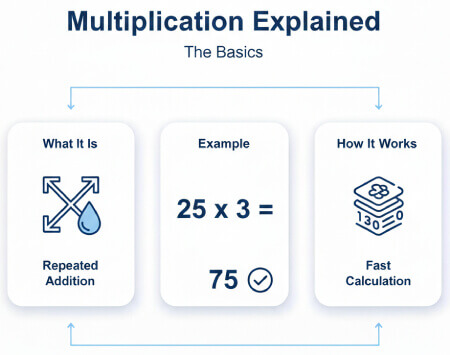
Multiplication is a condensed form of repeated addition: \(4 \times 7\) is the same as adding 7 to itself four times. For multi-digit numbers, the long multiplication algorithm (also called the standard algorithm) extends this by applying the Distributive Property: each digit of the multiplier is multiplied against the full multiplicand, and the partial products are offset by one place to the left for each successive digit. \[a \times (b + c) = a \times b + a \times c\] The Commutative Property (\(a \times b = b \times a\)) guarantees the product is the same regardless of which number you enter in which field, though the layout of the partial products will differ.
For decimal multiplication, the calculator temporarily treats both numbers as integers, multiplies them, then positions the decimal point by counting the total decimal places across both factors. For example, \(1.25 \times 0.5\) has three combined decimal places, so the product of \(125 \times 5 = 625\) becomes \(0.625\). For negative numbers, the sign rule applies: two numbers with the same sign produce a positive product; two numbers with opposite signs produce a negative product.
Useful Tips 💡
- Sign rule: two negatives make a positive. \((-8) \times (-5) = 40\), not \(-40\). One negative and one positive always give a negative result.
- Decimal precision: the number of decimal places in the product always equals the sum of decimal places in both factors. \(1.5 \times 0.04\) has three decimal places, so the result is \(0.060\).
- Do not use thousands-separator commas in the input fields (e.g., type 1000, not 1,000). Most calculators interpret a comma as a decimal separator in some locales, which changes the value entered.
📋Steps to Calculate
-
Enter the multiplicand (the number being multiplied) in the first field. Accepts integers, decimals, and negative numbers.
-
Enter the multiplier (how many times to multiply) in the second field.
-
Click Calculate to see the product, partial products, and decimal placement steps.
Mistakes to Avoid ⚠️
- Misaligning partial products in manual long multiplication: each successive row must shift one place to the left. Forgetting this shift underestimates the product by a factor of 10 per missed shift.
- Omitting zero placeholders: when a digit in the multiplier is zero, its partial product row is all zeros with the appropriate offset. Skipping it produces an incorrect sum.
- Incorrect decimal placement: count decimal places in both factors and sum them before placing the decimal in the product. A one-place error shifts the result by a factor of 10.
- Entering formatted numbers with commas as thousands separators: type 1000000, not 1,000,000, to avoid misinterpretation.
Practical and Professional Applications📊
Finance and budgeting: Annualize monthly figures by multiplying by 12. For example, 50,000 times 12 gives an annual salary of 600,000, and a monthly subscription of 29.99 times 12 gives an annual cost of 359.88.
Education: Verify factorization problems ("what times what equals 144?"), check homework answers, and understand the long multiplication standard algorithm step by step.
Construction and design: Scale blueprint dimensions, calculate material quantities, or adjust recipe amounts for large-batch catering. For example, 13.50 per unit times 8 units equals 108.
Science and data: Calculate totals from unit rates: total distance from speed and time, total cost from unit price and quantity, total area from length and width.