Circumference Calculator
Calculate the circumference of a circle from radius, diameter, or area using C = 2πr and C = πd. Also find radius or diameter from a known circumference.
Calculation Examples

How to Find the Circumference of a Circle
Identify which measurement you already have — radius, diameter, or circumference — and enter it in the corresponding field. Select your unit (inches, centimeters, meters, or feet). Click Calculate to get the result with full formula steps shown.
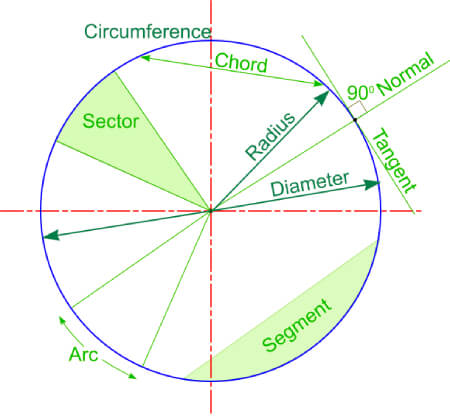
The radius is the distance from the center of the circle to any point on its edge. The diameter is the distance straight across the circle through the center, equal to twice the radius. If you enter the diameter into the radius field by mistake, your circumference will be exactly double the correct answer — the most common single error with this type of calculator. The tool can also work backward: enter a known circumference to find the radius (\(r = C / 2\pi\)) or the diameter (\(d = C / \pi\)). This reverse mode is useful when you have a fixed length of material (a strip of edging, a wire loop) and need to know what size circle it will form.
The Circumference Formula
The circumference of a circle follows directly from the definition of \(\pi\) (pi): the ratio of any circle's circumference to its diameter is always \(\pi\), regardless of the circle's size. This gives two equivalent formulas: \[C = 2\pi r \quad \text{(from radius)}\] \[C = \pi d \quad \text{(from diameter)}\] The calculator uses \(\pi \approx 3.1415926536\) (10 decimal places), consistent with the precision used in engineering and scientific computing. Using the common approximation 3.14 instead introduces a relative error of 0.0507% — small for a 10 cm circle (0.016 cm off) but significant for a 100-meter circular track (50 cm off).
To find circumference from area, first recover the radius: \(r = \sqrt{A / \pi}\), then apply \(C = 2\pi r\). For a circle with area 78.54 cm², \(r = \sqrt{78.54 / \pi} \approx 5\) cm and \(C = 2\pi \times 5 \approx 31.42\) cm. The calculator handles this two-step path automatically when area is the input.
Useful Tips 💡
- Use a caliper to measure diameter rather than a ruler: a caliper jaw spans the full diameter precisely, while a ruler requires you to locate the exact center by eye, introducing measurement error.
- The approximation \(\pi \approx 3.14\) is fine for quick mental estimates but introduces a 0.05% error. For a 10-meter diameter circular foundation, that is a 1.6 cm discrepancy in formwork length.
- To find the radius from circumference: \(r = C / (2\pi)\). To find the diameter: \(d = C / \pi\). These reverse formulas are built into the calculator.
📋Steps to Calculate
-
Select your input type: radius, diameter, circumference (to find the other dimensions), or area.
-
Enter the value and choose the unit (inches, cm, m, or ft).
-
Click Calculate to see the circumference and the step-by-step formula applied.
-
For reverse calculation (circumference to radius or diameter), enter the circumference and read the radius and diameter in the output.
Mistakes to Avoid ⚠️
- Entering the diameter value into the radius field: this produces a circumference exactly twice the correct answer, because the radius-based formula doubles the radius before multiplying by pi.
- Using pi = 3.14 for precision engineering: the error compounds with scale. For a 60-inch diameter circle, using 3.14 instead of 3.14159 gives 188.4 vs 188.50 inches — a 0.1-inch shortfall in a physical component.
- Mixing units within a calculation: entering radius in centimeters and expecting the result in inches without using the unit converter produces a result off by a factor of 2.54.
- Entering zero or a negative radius: a circle must have a positive radius. The circumference formula is undefined for non-positive values.
Practical and Engineering Applications📊
Manufacturing and materials: Calculate the exact length of edge banding, gaskets, O-rings, or trim needed to wrap a circular cross-section.
Mechanical engineering: Determine wheel or gear circumference to calculate distance traveled per rotation, gear ratio, or belt length.
Construction and architecture: Find the outer boundary of circular columns, arches, or curved walls for formwork, cladding, or finishing estimates.
Crafts and textiles: Measure the required length of ribbon, wire, or lace for circular hoops, frames, wreaths, or rings.