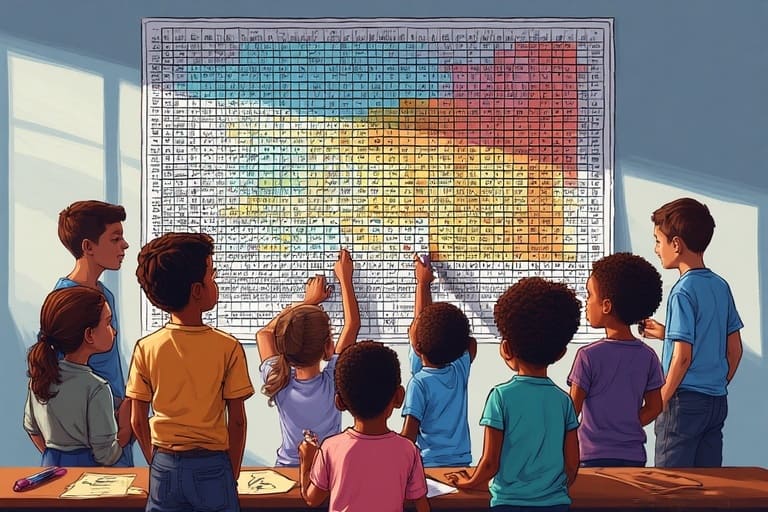
By arranging numbers row by row, from left to right, the grid transforms abstract counting into a physical map. While the 100-grid is the standard, teachers often use smaller versions, such as 1–20 grids, to help younger learners build confidence before moving on to larger calculations.
The Logic of the Grid
The real power of a number square lies in its geometric consistency. Because it is built on a base-10 system, the grid follows strict rules: moving one step to the right always adds 1, while moving one step down always adds exactly 10. This structure allows children to "see" place value in action. Instead of just memorizing that 24 + 10 = 34, a student can see that 34 is located exactly one row below 24. This visual reinforcement helps bridge the gap between simple counting and more complex mental arithmetic.
Beyond basic addition, the square serves as a canvas for discovering mathematical laws through visual patterns:
- Vertical and Horizontal Flow: Columns always end in the same digit, highlighting the consistency of units, while rows represent the progression of tens.
- Multiples and Symmetry: Multiples of 5 create two clean vertical lines, whereas multiples of 9 or 11 form striking diagonal bands across the grid.
- Prime Number Discovery: By systematically shading out multiples (a method known as the Sieve of Eratosthenes), students can visually isolate prime numbers as the "survivors" on the grid.
- Inverse Operations: Moving up the grid reinforces subtraction just as moving down reinforces addition, helping children understand that these operations are opposites.
Variations and Practical Applications
While the standard 1–100 grid is the most popular, there are several variations designed for specific skills. Multiplication squares, for instance, function as coordinate grids where the intersection of a row and a column reveals a product. Similarly, addition squares help students master "number bonds" by showing how different pairs of numbers can reach the same sum. Many modern classrooms now use digital, interactive versions of these grids, allowing teachers to hide specific numbers to create puzzles or generate random patterns for students to solve.
To make the most of this tool, educators and parents often engage students in interactive challenges:
- The Hidden Number Game: Cover random cells with counters or coins and ask the child to deduce the missing number using the logic of the surrounding cells.
- Number Square Puzzles: Provide a "fragment" of the square (a small cross-shaped piece of the grid) and ask the student to fill in the empty spaces based on the pm 1 and pm 10 rules.
- Pathfinding: Ask students to start at a specific number and follow "directions" (e.g., "Move two rows down and one column left") to find a target number.
A Foundation for Abstract Thinking
Ultimately, number squares are more than just posters on a classroom wall; they are a bridge to algebraic thinking. By recognizing that any number "x" on the grid has a neighbor "x+1" to its right and "x+10" below it, students begin to understand the formulas that govern mathematics. Whether used for simple counting or exploring the complexities of prime numbers, the number square remains one of the most versatile and effective tools for developing a deep, intuitive grasp of the world of numbers.