Power Conversion Calculator
Convert between watts, kilowatts, megawatts, mechanical horsepower, metric horsepower, and BTU/hr instantly. Uses NIST and BIPM-standard constants for electrical, automotive, and HVAC work.
Calculation Examples

How to Use the Power Conversion Calculator
Enter the power value you want to convert, select the source unit from the "From" dropdown, then choose the target unit. The result appears immediately.
The calculator covers the full range of power units used across different engineering disciplines: SI units (W, kW, MW, GW) for electrical and utility work; mechanical and metric horsepower for automotive and industrial machinery; BTU/hr and tons of refrigeration for HVAC and thermal engineering. All conversions pass through the watt as the SI base unit: $$P_{\text{target}} = P_{\text{source}} \times \text{Conversion Factor}$$ One important distinction before you start: power is the rate of energy transfer (watts = joules per second), while energy is power multiplied by time (kilowatt-hours = kW × hours). This calculator converts power units only. If you need to convert energy, use a dedicated energy converter.
Technical Standards in Power Unit Conversions
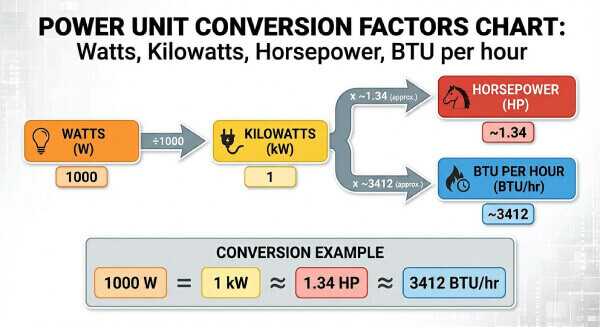
Power is formally defined as the rate at which work is performed or energy is transferred. The SI unit is the Watt (W), defined as one joule per second: \[1\text{ W} = 1\text{ J/s} = 1\text{ V} \cdot \text{A}\] All conversion factors in this calculator are maintained by NIST and BIPM. The key constants are:
- 1 mechanical horsepower (hp) = 550 ft·lbf/s = 745.69987 W exactly (by NIST definition)
- 1 metric horsepower (PS) = 75 kgf·m/s = 735.49875 W exactly
- 1 BTU/hr = 0.29307107 W (International Table BTU)
- 1 ton of refrigeration (TR) = 3,516.852 W = 12,000 BTU/hr
The 1.4% difference between mechanical hp (745.7 W) and metric PS (735.5 W) is the most common source of error in automotive power comparisons. A European car rated at 200 PS produces 147.1 kW; the same figure in U.S. mechanical horsepower would be 200 hp = 149.1 kW. That 2 kW gap matters when sizing drive components or comparing dyno results across markets. The calculator distinguishes all horsepower variants explicitly so you pick the right one for your context.
Useful Tips 💡
- Always confirm whether a horsepower rating is mechanical (hp), metric (PS), or electric (hp(E)). They differ by up to 1.4% and are not interchangeable in engineering specifications.
- Power is a rate; multiplying it by time gives energy. \(1\text{ kW} \times 1\text{ h} = 1\text{ kWh}\). If your goal is to calculate energy consumption or cost, you need the time component as well.
- For HVAC work, 1 ton of refrigeration = 12,000 BTU/hr = 3,516.852 W. This is the standard benchmark for sizing residential and commercial cooling systems in the U.S.
📋Steps to Calculate
-
Enter the numerical power value into the input field.
-
Select the source unit from the "From" dropdown (e.g., hp, kW, BTU/hr).
-
Select the target unit from the "To" dropdown.
-
Read the converted result instantly. For horsepower, confirm whether you need mechanical (hp), metric (PS), or electric (hp(E)) before selecting.
Mistakes to Avoid ⚠️
- Mixing mechanical horsepower (745.7 W) with metric horsepower/PS (735.5 W): a 200 PS European engine is not the same as 200 hp in U.S. specs. The difference is about 10 W per unit, or 2 kW at 200 units.
- Confusing power (watts) with energy (watt-hours): a 2,000 W heater running for 3 hours consumes 6 kWh of energy, not 6 kW.
- Assuming 1 BTU/hr equals approximately 1 W: the actual factor is 0.293 W per BTU/hr, so 1 W is 3.41 BTU/hr. The inverse is equally important for HVAC load calculations.
- Using rounded conversion factors in critical engineering work: the precise mechanical horsepower is 745.69987 W, not 746 W. At 500 hp, rounding to 746 W overstates the power by 1.5 kW.
Practical Applications📊
Electrical engineering: Convert watts to kilowatts for circuit load balancing, energy billing calculations, and solar panel output assessments.
Automotive industry: Translate engine output between kW and mechanical horsepower, or compare European PS ratings with U.S. hp specs on the same platform.
HVAC systems: Convert BTU/hr to kilowatts and tons of refrigeration to size cooling equipment and verify energy efficiency ratings (EER, COP).
Industrial machinery: Match motor nameplate ratings (often in hp) to electrical supply specifications (in kW) when sourcing equipment across different regional markets.
Questions and Answers
What is a power conversion calculator and why is it essential?
How do I convert watts to kilowatts accurately?
What is the difference between mechanical and metric horsepower?
How do you convert horsepower to watts for motors?
What is the conversion factor from BTU/hr to watts?
Is the watt an SI unit and how is it defined?
Which international standards does this power converter follow?
What are the most common power conversion factors for engineering units?
| Unit | Symbol | Value in Watts (W) | Scientific Notation |
|---|---|---|---|
| Picowatt | pW | 0.000000000001 W | \(10^{-12}\) W |
| Nanowatt | nW | 0.000000001 W | \(10^{-9}\) W |
| Microwatt | µW | 0.000001 W | \(10^{-6}\) W |
| Milliwatt | mW | 0.001 W | \(10^{-3}\) W |
| Kilowatt | kW | 1,000 W | \(10^{3}\) W |
| Megawatt | MW | 1,000,000 W | \(10^{6}\) W |
| Gigawatt | GW | 1,000,000,000 W | \(10^{9}\) W |
| Terawatt | TW | 1,000,000,000,000 W | \(10^{12}\) W |
| Petawatt | PW | 1,000,000,000,000,000 W | \(10^{15}\) W |
| BTU per hour | BTU/hr | 0.29307107 W | — |
| Mechanical Horsepower | hp | 745.69987 W | — |
| Metric Horsepower | PS | 735.49875 W | — |
| Electric Horsepower | hp(E) | 746 W | — |
| Boiler Horsepower | hp(S) | 9,812.5 W | — |
| Ton of Refrigeration | TR | 3,516.852 W | — |